


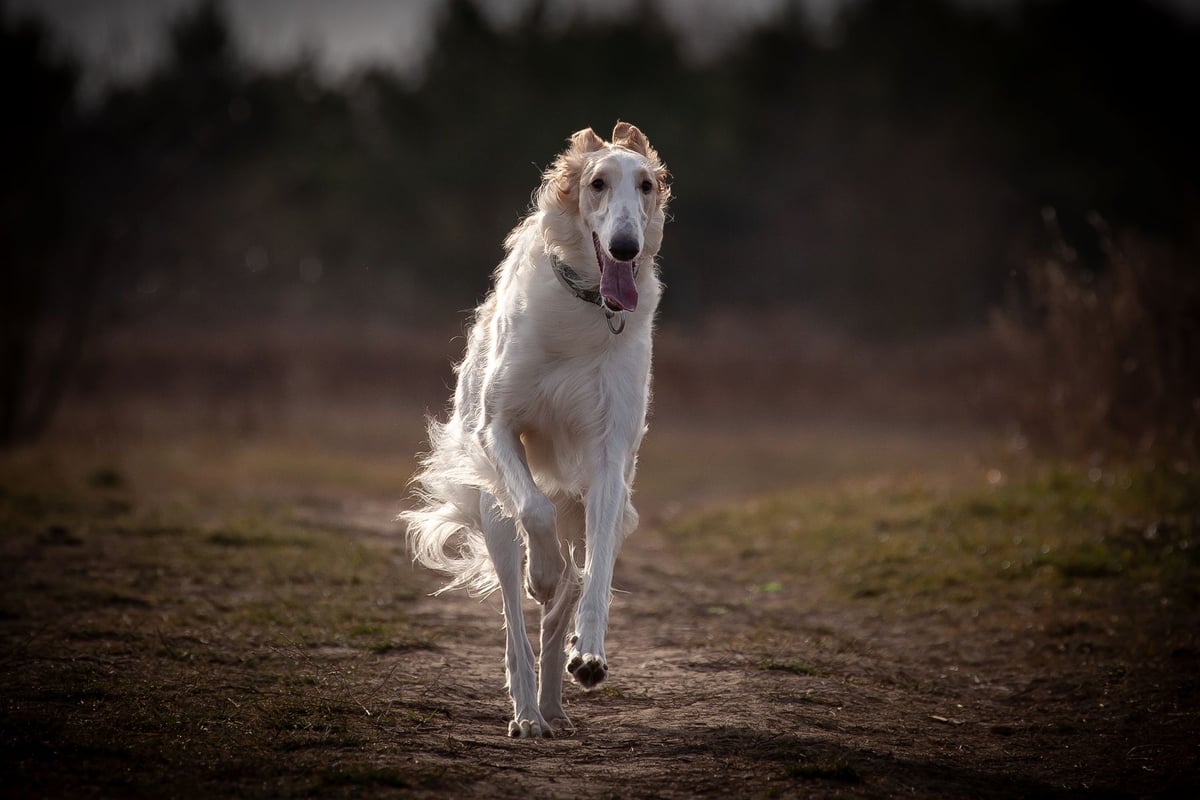
Borzoi
The Borzoi — Russian Hunting Sighthound, FCI number 193, Group 10 — was the dog of the Russian tsarist nobility, used for centuries to hunt wolves in packs: three dogs released together to hold the wolf until the rider arrived. It stands 75 to 85 cm at the withers for 34 to 48 kg, making it one of the largest and heaviest sighthounds. Life expectancy is 10 to 12 years.
- Weight
- 34 to 48kg
- Height
- 75 to 85cm
- Life expectancy
- 11years
- Monthly cost
- 100 to 170€
Personality profile
Energy 3/5
Independence 5/5
Trainability 2/5
Good with children 3/5
Barking 1/5
Space needed 4/5
Attachment to home 3/5
Good with strangers 1/5
Good with dogs 3/5
Good with cats 2/5
Coat care 3/5
Exercise needs 4/5
Scores given on measured axes, data confidence: high.
Living with a Borzoi
Description
A large, slender build with a convex profile (head and neck forming a characteristic curve), a long, wavy or curly coat, denser at the neck (a mane), on the flanks, and in the plumed tail. The coat is generally white with fawn, gray, or black markings, but all colors are permitted under the FCI standard. Males stand 75-85 cm at the withers for 40-48 kg; females are lighter, 34 to 44 kg, and slightly shorter. A very deep, narrow chest and a strongly tucked-up abdomen — a build typical of sighthounds at high risk for gastric torsion.

Temperament
Described in Russian dog-breeding records as a 'distant aristocrat': deeply attached to its close family, it remains fundamentally reserved and can completely ignore strangers without any sign of aggression. Before the 1917 revolution, its breeding was a codified aristocratic privilege — this selection for composed, low-reactivity individuals produced a temperament that is stable but not very demonstrative. Its sight-hunting instinct is intact and powerful; any fleeing animal triggers a chase that a verbal recall cannot interrupt.
Training
It obeys by choice, rarely by conditioned reflex: sessions of 8 to 12 minutes maximum with positive reinforcement and high-value rewards. Its independent nature makes classic obedience sports poorly suited to it; on the other hand, it excels at FCI lure coursing and sighthound coursing, which draw on its genetic predisposition. For first-time owners, guidance from a sighthound-specialized dog club is strongly recommended — coercive methods produce an inhibited dog without improving obedience.

Feeding
650 to 850 g of premium kibble a day for a 40 kg adult, always split into 2 meals (never a single meal — GDV risk). Avoid any intense exercise in the hour before and after a meal. An elevated food bowl is not recommended (contrary to a widespread belief, recent studies show no anti-GDV benefit). Weigh the ration: the breed's metabolism is economical, and weight gain on a sighthound is hard to spot visually.
Affiliate links, no extra cost to you. Legal notice

Living conditions
A house with a fence at least 2 m high is required: the Borzoi can clear 1.5 m without a running start and reaches 55-60 km/h on open ground. Apartments are not advisable unless daily access to a large, secure open space is guaranteed. Despite its imposing size, it is calm indoors and does not become destructive if its exercise needs are met — 1 to 1.5 hours of activity a day in two sessions. Its cold tolerance is good (a thick, wavy coat), but it cannot handle an unheated kennel through a Russian winter.

Grooming and coat care
Brush 2 to 3 times a week for the long, wavy coat: the neck mane and leg feathering are the areas most prone to tangling. The breed sheds twice a year with significant hair loss — more frequent vacuuming and brushing are needed during shedding season. Professional grooming 3 to 4 times a year to even out the feathering. Bathe monthly with a mild shampoo; the drop ears need a weekly check.

Health
Life expectancy is 10 to 12 years. Two major documented risks in the breed: osteosarcoma (bone cancer, at a significantly higher rate in large sighthound breeds) and gastric dilatation-volvulus (GDV) — an absolute surgical emergency favored by the deep, narrow chest. GDV warning signs: a bloated belly, unproductive attempts to vomit, hypersalivation. Like all sighthounds, it has a particular sensitivity to barbiturate anesthetics — always inform the vet before any sedation. Hip dysplasia remains present at a moderate level.
Breed history
The Borzoi — whose name means 'fast' in Old Russian — is documented in Russian manuscripts of the 17th century as a dog of the high nobility. The state kennels of the great aristocratic families (the Romanovs included) could hold several hundred dogs; the pack hunt of wolves with 3 borzois was a codified ritual: the dogs seized the wolf by the neck and held it until the rider arrived and pinned it down by hand. The October Revolution of 1917 brought the breed to near extinction: as aristocrats were eliminated, their dogs were killed or abandoned. A few had already been exported to Western Europe and the United States — the breed was saved through these diaspora lines. Standardized by the FCI under number 193.
Getting ready for your Borzoi
Five essentials to line up before day one.
Affiliate links, no extra cost to you. Legal notice
FAQ: Borzoi
Sources
- FCI Standard No 193 — Borzoi · FCI breed standard 193, Group 10 Sighthounds, Section 1 Long-haired or fringed Sighthounds
- AKC Breed Profile — Borzoi · AKC Borzoi breed profile, Hound Group
- Société Centrale Canine — Borzoi Standard · SCC, breed standard for the Borzoi (Russian Sighthound), Group 10, section 1
FCI, Fédération Cynologique Internationale, the world body that has codified breed standards since 1911. FCI number 193 is assigned to the Borzoi.

