


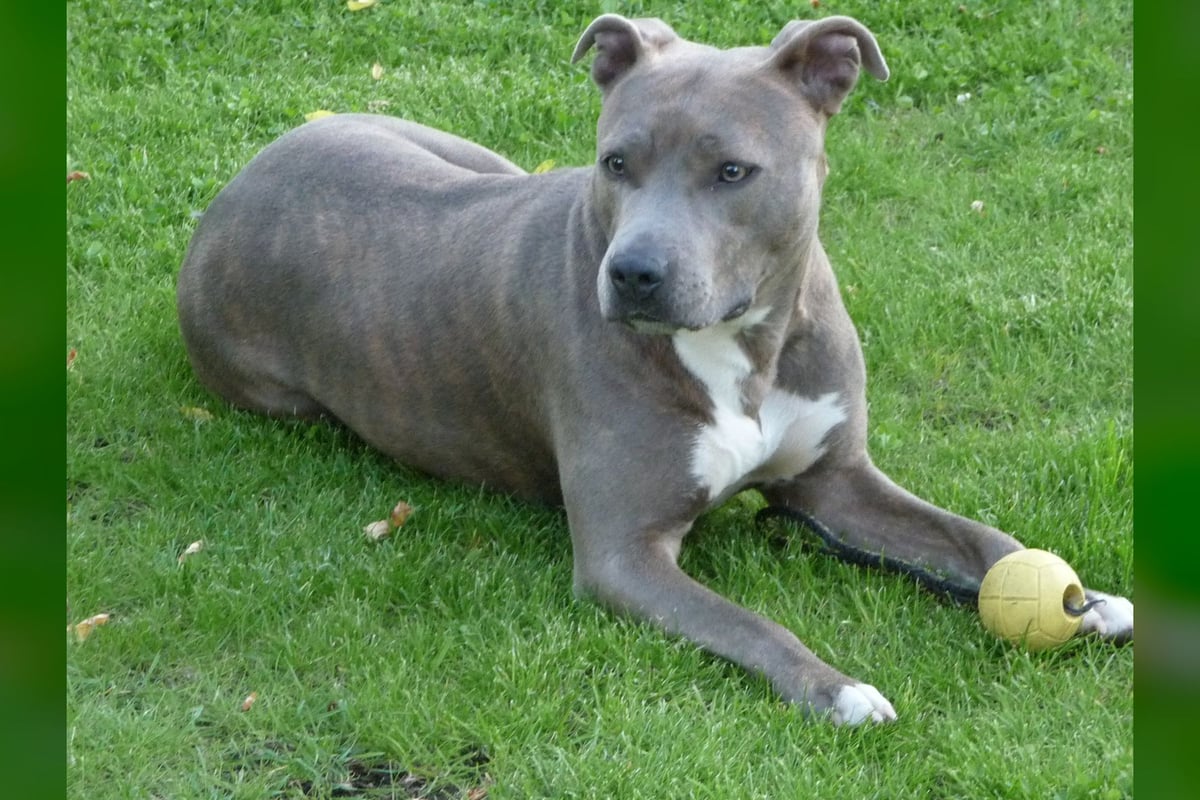
American Staffordshire Terrier
The American Staffordshire Terrier weighs 18 to 30 kg for 43 to 48 cm at the withers. Recognized by the FCI under number 286, Group 3 Terriers, Bull type section, native to the United States. The breed is categorized in France under the law of January 6, 1999: dogs registered with the LOF fall under Category 2 (guard and defense dogs), while dogs without a recognized pedigree fall under Category 1 (attack dogs), whose acquisition and transfer are banned. Not to be confused with the Staffordshire Bull Terrier (FCI 76), a British breed not categorized in France. Life expectancy is 12 to 14 years. Documented predispositions: osteosarcoma, hereditary cerebellar ataxia, hip dysplasia, skin atopy.
- Weight
- 18 to 30kg
- Height
- 43 to 48cm
- Life expectancy
- 13years
- Monthly cost
- 80 to 130€
Personality profile
Energy 4/5
Independence 3/5
Trainability 3/5
Good with children 4/5
Barking 3/5
Space needed 4/5
Attachment to home 4/5
Good with strangers 2/5
Good with dogs 2/5
Good with cats 2/5
Coat care 2/5
Exercise needs 4/5
Scores given on measured axes, data confidence: high.
Living with an American Staffordshire Terrier
Description
A medium-sized to stocky breed, powerfully muscled for its weight. Males stand 45-48 cm for 25-30 kg, females 43-45 cm for 18-25 kg. The coat is short, close, hard to the touch, and glossy. All colors and combinations are permitted, but the standard discourages solid white or white covering more than 80% of the coat, black and tan, and liver. A broad head with a pronounced stop, powerful jaws, and pronounced cheekbones. A compact body with well-muscled legs. Ears are rose or half-pricked — cropping (surgical removal of the ear flaps) has been illegal in France since 2004 but persists illegally in some imported lines. It is more imposing than the British Staffordshire Bull Terrier it descends from, through import and selection in the United States since the mid-19th century.

Temperament
Courageous, tenacious, stable under stimulation. High energy level and strong physical stamina. Attached to its family, tolerant with the household's children known since puppyhood — constant supervision is essential given its size and power. Wariness of strangers varies, without systematic aggression in a balanced dog. Intolerance of other dogs is possible, particularly pronounced between intact males — intensive early socialization before 4 months is decisive. The breed is not a guard dog in the strict sense: its alertness toward intruders varies by line.
Training
Trainability is intermediate: sharp, motivated by human contact and play, but a terrier temperament that produces stubbornness. Positive reinforcement with high-value treats and tug play. Consistent rules are essential — an owner's hesitation is quickly exploited. Inter-dog socialization before 4 months is the top priority for limiting intolerance of other dogs as an adult. Dog sports suited to its build and energy: canicross, weight pull, obedience, agility. An owner experienced with strong-willed breeds is recommended.

Feeding
200 to 300 g of premium kibble a day for a 25 kg adult, in 2 meals. A breed with an active metabolism and dense muscling: adjust the ration to actual exercise intensity to avoid weight gain (obesity worsens dysplasia). Hypoallergenic food (single-source, hydrolyzed, or novel protein) for atopic dogs. Count treats toward the daily ration. Glucosamine/chondroitin supplements from age 4 for sporting dogs.
Affiliate links, no extra cost to you. Legal notice

Living conditions
A house with an enclosed garden is preferable — apartment living is not advisable without a sustained daily commitment and immediate access to outdoor space. At least one hour to an hour and a half of physical activity per day: brisk walking, running, intense play, dog sports. A short coat with no undercoat: sensitive to cold, provide warm indoor bedding and a coat for prolonged winter outings. Do not leave alone for more than 4 to 5 hours — strong family attachment, possible separation anxiety. In France, its status as a categorized dog imposes strict legal constraints that shape day-to-day management (see FAQ).

Grooming and coat care
Minimal upkeep: weekly brushing with a rubber curry glove, monthly or twice-monthly bath with a mild shampoo. Short coat, sheds moderately year-round. Weekly inspection of skin folds on dogs with loose skin (risk of intertrigo). Brush teeth 2 to 3 times a week — the breed is prone to tartar. Check nails monthly. Atopic dogs need specific dermatological shampoos and closer skin monitoring.

Health
Life expectancy is 12 to 14 years. Documented genetic predispositions. Osteosarcoma (primary bone cancer) is overrepresented in the breed and in breeds descended from the Bulldog-Terrier type; prognosis is poor without early treatment, amputation plus chemotherapy. Hereditary cerebellar ataxia: a progressive neurological disorder affecting motor coordination, documented in the breed, with no curative treatment — a DNA test is available from certain laboratories. Hip dysplasia: radiographs of breeding stock are mandatory at serious kennels, screening recommended from 12 months for sporting dogs. Skin atopy (allergic dermatitis): chronic itching, secondary infections, managed for life with hypoallergenic food and dermatological treatment.
Breed history
A breed descended from the Staffordshire Bull Terriers imported to the United States starting in the 1850s for dog fighting — a practice progressively banned in the United States from 1874 onward, depending on the state. American selection moved toward a more imposing size and a stockier build than the British model. Recognized by the AKC as the Staffordshire Terrier in 1936, renamed the American Staffordshire Terrier in 1976 to officially distinguish the breed from its British cousin. Recognized by the FCI under number 286, Group 3, Bull type Terriers section. In France, the law of January 6, 1999 on dangerous and stray animals placed it among categorized dogs, due to its build and historical use in fighting: Category 2 for dogs with a recognized pedigree, Category 1 otherwise.
Getting ready for your American Staffordshire Terrier
Five essentials to line up before day one.
Affiliate links, no extra cost to you. Legal notice
FAQ: American Staffordshire Terrier
Sources
- FCI Standard No 286 · FCI breed standard 286, Group 3 Terriers, Section Bull type Terriers, Country of origin USA, recognized 1936
- AKC Breed Profile — American Staffordshire Terrier · AKC American Staffordshire Terrier breed profile, Terrier Group, height 17-19 in (43-48 cm), weight 40-70 lbs (18-32 kg)
FCI, Fédération Cynologique Internationale, the world body that has codified breed standards since 1911. FCI number 286 is assigned to the American Staffordshire Terrier.
Breeds similar to an American Staffordshire Terrier


Boxer
Pinscher and Schnauzer - Molossoid and Swiss Mountain and Cattledogs
25 to 35 kg