


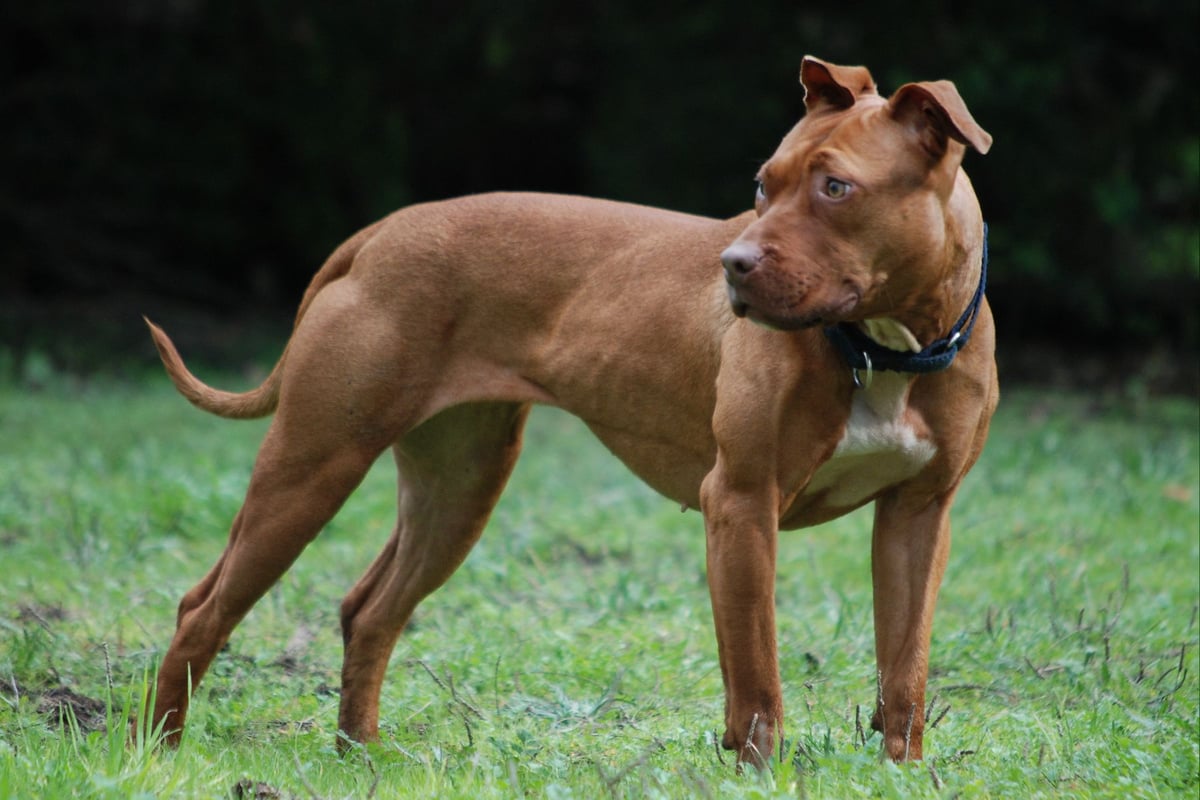
American Pit Bull Terrier
The American Pit Bull Terrier (APBT) is recognized by neither the FCI nor the AKC — it has been registered since 1898 by the United Kennel Club (UKC), the first American dog registry to dedicate a standard to it. The breed has been classified as Category 1 (attack dogs) in France since the law of January 6, 1999 (No. 99-5): import is banned, ownership requires a mandatory permit, spaying/neutering is mandatory, and muzzling and leashing are required in all public places. Adult weight is 14 to 27 kg for 43 to 53 cm at the withers, with a life expectancy of 12 to 14 years.
- Weight
- 14 to 27kg
- Height
- 43 to 53cm
- Life expectancy
- 13years
- Monthly cost
- 80 to 140€
Personality profile
Energy 5/5
Independence 3/5
Trainability 3/5
Good with children 3/5
Barking 3/5
Space needed 4/5
Attachment to home 4/5
Good with strangers 2/5
Good with dogs 2/5
Good with cats 2/5
Coat care 1/5
Exercise needs 5/5
Scores given on measured axes, data confidence: medium.
Living with an American Pit Bull Terrier
Description
A medium-sized breed with an athletic build and dense muscling. Males stand 45-53 cm for 16-27 kg, females 43-50 cm for 14-23 kg — the UKC standard does not impose strict limits and accepts a range of sizes. A broad, brick-shaped head with a defined stop, strong jaws, and round-to-oval, slightly almond-shaped eyes. The coat is short, smooth, and slightly stiff to the touch. All colors are permitted under the UKC standard, except merle (which carries genetic defects). A compact, powerful body, a fine, low-set tail, and straight legs with visible muscling.

Temperament
A strong attachment to humans, particularly pronounced toward its immediate family — a trait intentionally selected to counterbalance the breed's history as a fighting dog. High physical stamina and one of the most sustained energy levels among terriers: 5/5. Intolerance of other dogs is documented in the breed and must be managed with early socialization before 4 months; multi-dog cohabitation is possible but requires rigorous oversight. Moderate wariness of strangers, without systematic aggression in stable dogs.
Training
Motivated by human contact and responsive to positive reinforcement: high-value treats and tug play are the most effective tools. A pronounced terrier tenacity: long, repetitive sessions produce passive resistance. Keep sessions short (10-15 min), varied, and high-reward. Inter-dog socialization before 4 months is the non-negotiable critical point for limiting intolerance of other dogs as an adult. Suitable dog sports: canicross, weight pull, competitive obedience. An owner experienced with muscular, strong-willed breeds is essential.

Feeding
200 to 350 g of premium kibble a day for a 20 kg adult, in 2 meals. A formula rich in animal protein (≥ 28%) is recommended to support muscle mass and limit skin flare-ups. Hypoallergenic food (single-source or hydrolyzed protein) for atopic dogs. Adjust the ration to actual exercise intensity — the breed has a fast metabolism under heavy activity and tends toward weight gain when under-exercised. Glucosamine and chondroitin supplements from age 4 for sporting dogs.
Affiliate links, no extra cost to you. Legal notice

Living conditions
A breed with high exercise demands: at least one to two hours of sustained physical activity a day (canicross, swimming, intense play). A house with an enclosed garden is strongly recommended; apartment living is not advisable without a firm daily commitment and immediate access to spaces for exertion. A short coat with no undercoat: sensitive to cold, indoor bedding is required, and a coat is needed for prolonged winter outings. In France, dogs present in the country descend from lines predating 1999 (import is now banned) — any legal acquisition requires verifying declaratory status with the town hall.

Grooming and coat care
Minimal upkeep: weekly brushing with a rubber curry glove removes dead hair and stimulates skin circulation. Shedding is moderate and continuous, without a pronounced seasonal molt. Bathe monthly with a mild or oatmeal-based shampoo for dogs with sensitive skin. Weekly skin inspection, particularly for white or light-coated dogs (prone to irritation and sunburn). Check nails monthly. Brush teeth 2 to 3 times a week.

Health
Life expectancy is 12 to 14 years. Hip dysplasia: overrepresented in heavily muscled breeds, radiographs of breeding stock are recommended. Demodectic mange: a documented predisposition, caused by transient immunosuppression — mainly affecting young dogs from 3 months to 2 years, treatment is available. Chronic skin atopy with itching and secondary infections. Hypothyroidism: fatigue, weight gain, dull coat, TSH testing is available. Patellar luxation in lighter-framed dogs. An OFA evaluation is recommended for breeding stock.
Breed history
The APBT descends directly from the British Bull-and-Terriers imported to the United States starting in the 1840s-1870s — crosses of English Bulldogs and English White Terriers used for dog fighting. These same Bull-and-Terriers are the common ancestor of the Staffordshire Bull Terrier and the American Staffordshire Terrier; the American and British selections diverged morphologically over the following decades. The United Kennel Club recognized a standard for it as early as 1898, making the APBT one of the first breeds officially registered in the United States. The AKC declined to recognize it and chose instead to register the American Staffordshire Terrier separately in 1936. In France, the law of January 6, 1999 (No. 99-5) classified it as Category 1 (attack dogs), banning any new imports from that date.
Getting ready for your American Pit Bull Terrier
Five essentials to line up before day one.
Affiliate links, no extra cost to you. Legal notice
FAQ: American Pit Bull Terrier
Sources
- UKC Standard — American Pit Bull Terrier · United Kennel Club breed standard, American Pit Bull Terrier, registered 1898, Terrier Group
- Légifrance — Law No. 99-5 of January 6, 1999 · Law No. 99-5 of January 6, 1999 on dangerous and stray animals — Category 1 (attack dogs) classification, import ban, ownership requirements
- Société Centrale Canine — Categorized Breeds · SCC guide to categorized dogs in France — Category 1 and 2, legal requirements, ownership permit, behavioral assessment
Breeds similar to an American Pit Bull Terrier

